
Why Publish

Welcome! We’re starting our Substack adventure with an introduction of sorts. If I’m asking strangers for mental timeshare, especially in a hyper-saturated media environment, it feels important to offer up a “why.” So this is my overdue explanation of what the hell is going on over here at As Is Press.
Let’s begin with what this article is not. This is not a manifesto. I don’t pretend to know how to “fix” publishing. And I’m not egotistical enough to even gesture towards advice or admonishment. We’re doing our own thing over here, and it’s not for everyone.
If there’s an operating principle at As Is Press, it is this: we need a multiplicity of stories and ways of telling them. We need people finding the gaps that only they can fill. We need people amplifying the voices they’re close to that need amplifying.
If you’re paying attention, new stories are whispering to you. How do we help nourish them? If anything, this is a call to slow down. To really listen. And then to share.
A little background
It’s 2023. After years of working in bookstores and for independent publishers, I’d escaped the book business. I was in LA, living the dream of a struggling screenwriter in a dying industry during a pandemic. It was wonderful out here. The water was fine.
So there I was, happy simply reading books, when a Dear Friend handed me his manuscript about a non-dual spiritual experience he’d had. I’d been in conversation with Dear Friend as they’d unpacked this pretty wild (though surprisingly not uncommon) event, and now that they’d finished a book about it, they wanted my advice. Was it “publishable?” He wanted to release the book anonymously — it made sense thematically, and he had no interest in becoming a guru — but that definitely made the book less appealing to a traditional publisher.
Of course, when I read the book, I fell in love. I was overcome by the rare certainty that I was reading “something special.” Something that needed to be in the world. And I was, to my surprise, compelled to publish this little note on nothing.
But I was also troubled by what publishing again implied. Aren’t there more than enough books? And more than enough people publishing them? These questions got me thinking about how I could publish in a way that nurtured everyone involved. I didn’t want to be another business fighting to survive inside extractive capitalism. If I was going to start a press, I wanted to do it in the spirit of the kind of book I wanted to publish.
What makes As Is Press “unusual”
Our authors keep the rights to their books. We only have the right to sell the books we pay to print. As a writer, this is an existential concern. Authors should hold the rights to their work in perpetuity. If I’m doing right by you as an author, and we’re nourishing our relationship, then we’ll joyfully continue publishing together. If it’s not working out, we’ll go our separate ways.
We also don’t take the rights to our author’s books because our intention is not to turn a profit. We’re doing this to help these stories reach as many people as possible. I want to make my authors money. I will work my ass off to sell as many copies of a book as I can. But I don’t ever want to publish a book because I think it will make the press a profit. I’m overly firm with myself on this point because it’s really hard to hold on to.
The moment I start to consider if a book will make money, I stop asking the questions that are really important: Does this book need to be in the world? And am I the person to help midwife it?
There are too many books — too many to thoughtfully read. And we spend too many hours every day distracting ourselves into torpor. Personally, I have to turn down the deafening noise of scarcity to actually listen and hear if a book is speaking to our longing for a different future.
Can somebody else do a better job with this book? Of the books that need a publisher, very few of them should be published by me. Most publishers have budgets and staff and other resources I don’t.
This is not to say that I’m publishing books I don’t think will appeal to, or reach, lots and lots of readers. I very clearly see the market for the books we’re working on. I know they’ll sell incredibly well for a long time. But that’s not why I’m publishing them. And to be honest and rigorous with myself, I’ve had to set clear boundaries. Which is partly why we publish so few books! I don’t come across a lot of manuscripts that are a good match. And I want to be able to always give time to the books we have published. Books are living things; they need tending.
Which brings me to my favorite thing about this publishing experiment. We give our books support for as long as we’re representing them. There are no marketing or publicity windows. I love these books, and my understanding of them and how to help them be in the world is only going to deepen over time.
This is slow publishing. Fewer books. More attention.
So what makes a manuscript an “As Is Press book”? Well… I don’t know. Not in a categorically defined way.1 As cheesy as it is, I know it when I read it. Signposts to a brighter future? Like all boutique presses, maybe they’re just books I want to read. Books that make me cry from yearning. Books I can clearly see becoming beautifully designed little spells that can fit in the back pocket of your jeans.2
So how’s it going?
Pretty well! In a little over a year, we’ve sold over 2,000 copies of Notes on Nothing, which, considering our $0 marketing budget and lack of traditional distribution, is remarkable. (For those that don’t know, the dark secret of publishing is that most books don’t sell. Especially from first-time authors. Never mind anonymous ones.)
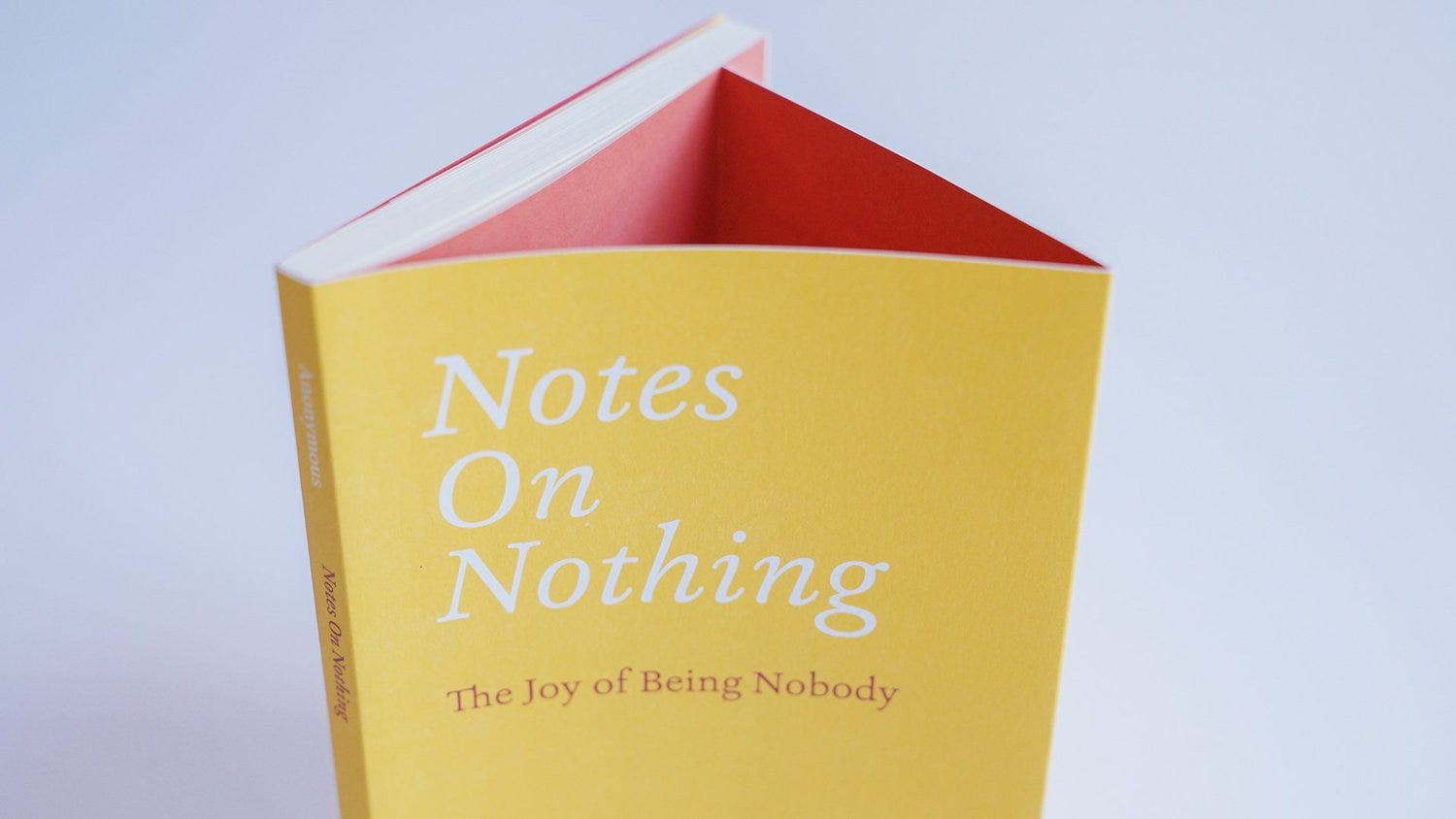
Notes on Nothing continues to sell really well. And I think part of that is the design. Anonymous and I took a lot of time to make sure it felt right. If you’re going to ask the world for the resources to mass-produce a physical object, it’s only right that you give that sacrifice the consideration of loving design. Humbly, I think we nailed it. Though I’ll probably futz with the size of French flaps again on the 3rd printing…
All to say, we’re breaking even. Which was the plan all along. And that’s entirely thanks to indie booksellers.3 The unsung heroes of the book world. People who have held the book in their hands and wanted to put it in the hands of others. There are too many to thank by name, so I have to give an insufficient “THANK YOU!” to all of them. Ditto to our incredible distributor Asterism. John took a risk on us, and I don’t know if we’d be publishing more books without them.
Easily the best part of running a press is walking into bookstores, meeting booksellers, and introducing them to Notes and the mission of the press. Being a traveling salesperson got a bad rap. It’s delightful, and it works.
What’s next!
A few months ago, the brilliant Dougald Hine sent me a manuscript by farmer/philosopher Adam Wilson. I’ll be saying more about this magical book soon, but you can read about Adam on his Substack and find out more about the forthcoming This Food Is a Gift here.
Getting to know Adam these last few weeks has been a tremendous honor. I’m beyond grateful to him for his trust. And I’m excited to be working with the lovely people at Hancock House Publishing to help bring Adam’s book into the world. This one is a real heart sprouter. It put me through the wringer, and I hope it does the same for you.
While it will be available for sale in all the usual places, This Food Is a Gift ended up in my hands because Adam wants the book to also be available to people as a gift. Meaning readers won’t have to pay for it in the traditional transactional sense. We’re currently figuring out how to do that logistically, so follow us for announcements on when/where/how you can request a copy.
We’re also wrapping up editing Alejandra Villegas’s Conjuring Heaven in Hellish Places, a grimoire, or book of ritual magick, written for and used by those serving time in the U.S. prison system. Our goal is to donate one book for every book we sell. If anyone has a good contact with a Prison Books Program, please send it over.
How can we support each other?
Thank you for taking the time to read this. If you’re here, you’re already a supporter, and we appreciate you. If you’re a writer, keep writing. Please. This world needs your courage and your imagination more than ever.
Everything we publish on Substack will be available to read for free, always. But if you want to support the mission of the press more generally, you can subscribe. Or go buy a book!
In the next few months, if people are interested, we’ll probably put out some more pieces about publishing. We’ll share more about forthcoming titles. And I’m hoping Anonymous will grab the aux and post on the channel a bit. We’ll see. Like everything we’re doing, it’s an experimental space.
With love, rage, and endless curiosity, always
C.C. Day
Publisher
As Is Press
We don’t publish fiction. Someone else can do a better job. So don’t send me your novel!
Seriously, why are books so big and expensive? I don’t know if we’ll ever publish a hardcover. They’re inaccessible and obnoxious to read in the wild.
Our books are for sale on Amazon, but it does nothing for us, and I’m thinking of pulling them. The juice isn’t worth the squeeze. And I feel awful giving Jeff money.
Very heartwarming to hear ur love of books and wanting to nurture a few select into the world in the most mindful and in my opinion sacred way. As a writer it is encouraging and hopeful to me. 💙👍🙏💫
What a wholesome initiative! Thank you for manifesting it.